Showing posts with label Forex News. Show all posts

Tuesday, 17 December 2013

Euro Activities As Fluidity Tightens

by Unknown  |  in Rates at  04:39
Two Euro coins are seen after being minted in the Austrian Mint (Muenze Oesterreich) headquarters in Vienna June 20, 2013. REUTERS-Leonhard Foeger


A firmer reading from the German ZEW economic sentiment survey, due at 0500 ET, will likely support the euro, while a lower-than-forecast number could see it give up recent gains. On Monday a German PMI survey beat expectations.
The euro rose 0.1 percent against the dollar to $1.3772. The common currency also stayed within reach of a five-year peak against the yen, rising about 0.1 percent to 141.82 yen.
The euro also rose against the Swedish crown after the Riksbank cut the repo rate as expected. The crown fell to a session low of 9.0791 per euro in high volumes after the central bank struck a dovish note by lowering the rate path.
The single currency has shrugged off some poor recent economic data - particularly inFrance - to surprise many analysts and move higher since the summer.
A key driver has been tighter money markets, as banks repay cheap European Central Bank loans. Liquidity usually tightens towards the end of the year anyway, when banks hold off from lending to each other.
This year, another factor driving euro strength is European banks repatriating funds to shore up their capital bases before an ECB Asset Quality Review (AQR). EU banks reduced their assets by 817 billion euros between December 2011 and June 2013, according to the European Banking Authority.
"(Euro/dollar) above $1.35 is not fundamentally justified if you look at what's happening in the U.S. and Europe. But underlying flows are euro-positive," said Carl Hammer, chief currency strategist at SEB in Stockholm.
"Obviously everyone is waiting for the Fed decision. We are looking for the Fed to initiate cautious tapering," he said. He expects bond-buying to be reduced by $5-10 billion and the unemployment threshold - when the Fed would consider raising interest rates - to be lowered to 6 percent.
The Fed begins its latest two-day policy meeting on Tuesday. A majority of economists polled by Reuters expect it to taper its huge bond-buying program in March, although the odds on a move this month or next have shortened after a run of upbeat data.
The dollar, which hit a five-year high of 103.925 yen on Friday, was down marginally at 102.97 yen. There was talk among traders of options expiring at the 103 yen level, which could help keep the Japanese currency at these levels.
U.S. economic data continues to suggest improving prospects, with industrial production posting its biggest increase in a year in November, finally pushing industrial output above its pre-recession peak.
"Some of the momentum that we saw in some currencies, like dollar/yen, euro, sterling, it seems to have faded at the moment, which could be partly going into year-end with less liquidity and some profit-taking, which could be limiting moves," said Mitul Kotecha, head of global foreign exchange strategy for Credit Agricole in Hong Kong.
The Australian dollar fell 0.2 percent to $0.8934, heading back towards the more-than-three-month low it hit on Friday, after the release of the minutes of the Reserve Bank of Australia's December 3 policy meeting. The RBA said the Aussie is still uncomfortably high despite the fact it has weakened noticeably over the past month.

Australia's government has also abandoned any intentions of returning to a budget surplus and predicted deficits for the next decade without spending cuts.

Monday, 16 December 2013

Gold bumps to the highs of the day in a vote for no taper

by Unknown  |  in Rates at  07:45
It’s all about the taper this week. With stocks higher and now gold joining in the fun, the market is saying that a taper is less likely. Prices are up $4 to $1242 after falling as low as $1220 on Friday.
There is an infinite amount of chatter on what the Fed will do Wednesday. CitiFX breaks down how it sees economists:
  • 35% expect a Dec taper with some dovish comments to soften the blow, like a commitment to low rates for longer
  • 25% expect no taper but a solid commitment to one in January in the statement
  • 20% say no taper with Fed saying they need to see a longer period of improvement in labor and the economy
  • 15% no taper and with non-committal but more hawkish language
  • 5% looking for a taper with no additional dovish language  

Australian Dollar Skidding Along the Back Although Appearing a Fluctuate

by Unknown  |  in Trading at  07:24
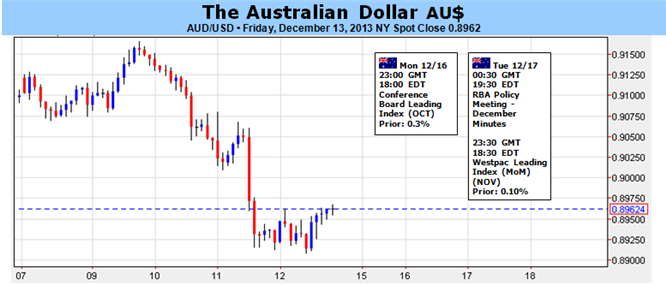
AUD/USD has declined for 8 consecutive weeks for the first time in more than 20 years. The pair tried the downside again today, touching as low as 0.8920 but has rebounded to 0.8956, down just a handful of pips on the day as risk appetite improves.
Bids rest down at 0.8920 with a barrier at 0.8900. The overnight high in Asia was 0.8965 with offers beginning at 0.8985 with more at 0.9000 and buy stops above 0.9020.
I like a bounce here but it’s tough to take sides ahead of the FOMC..

Apportion Us Many at Cost Money Chatters Portugal

by Unknown  |  in Trading at  07:18
To help aid the exit from the bailout the Portuguese deputy minister for Europe wants some cheap money from Europe.
The loans are part of a scheme being floated about to offer member states as an incentive for carrying out economic reforms and will be up for discussion at a senior officials meeting on Wednesday.
As the last five years of turmoil haven’t been incentive enough for countries to get their houses in order I’m fully supportive of the scheme 
money down-toilet

December US effects state constructing index 0.98 vs 4.75 exp

by Unknown  |  in Rates at  07:16
  • Prior -2.21
  • Employment unchanged at 0.0
  • New orders -3.54 vs -5.53 in Nov
  • Prices paid 15.66 vs 17.11 prior
  • Business conditions 35.72 vs 37.51 prior
A recovery of sorts from last month but not one that’s cause for a ticker tape parade. As has been the case with these types of surveys the employment component is still floundering. Makes you wonder where all the jobs are coming from .....
US Empire state mfg 16 12 2013

Canadian Nov Existing Home Sales

by Unknown  |  in Stock Exchange at  07:14
Data from CREA:
  • Prior reading was -3.2%
  • Prices up 4.1% vs Nov 2012
  • Sales rose 5.9% y/y
This data set has been under fire for inaccuracy, in particular, the way it handles revisions. At face value, it’s the second month in a row of declines but nothing to worry about. CREA says the market is in ‘balanced’ territory, which is no surprise coming from an association of realtors.
CREA existing home sales

US Account Bonds Not Appointed to the Bin Due Yet

by Unknown  |  in Trading at  07:12
The US saw a turnaround in capital outflows in October from $97.6bn to inflows of $194.9bn.
Foreign buyers picked up $39.7bn in Treasuries from $28.5bn in Sep while Japan’s holdings fell marginally to $1.174tn from $1.178tn prior. China increased theirs to $1.305tn from $1.294tn.
Foreign buyers of equities took a fall to $7.8bn from $14.7bn
US capital flows 16 12 2013

US industrial production 1.1% vs 0.5% exp m/m in November

by Unknown  |  in Markets at  07:07
  • Prior -0.1%
  • Manufacturing 0.6% vs 0.4% exp. Prior 0.3%
  • Capacity utilisation 79.0 vs 78.4 exp. Prior 78.1
Motor vehicles and parts lead the way rising to 3.45 from -1.3% prior, Utilities +3.9% from -0.3% in Oct, Mining industries +1.7% vs -1.5% prior, consumer goods +1.5% from -0.1% prior. The same sectors saw decent gains in capacity utilisation also.
USD/JPY shrugs off the numbers but cable and the euro continue to slide.
US Industrial production 16 12 2013
US capacity utilisation 16 12 2013

US Stocks Jump At The Open Market

by Unknown  |  in Stock Exchange at  07:04
The S&P 500 is up 14 points to 1790 shortly after the open. The index was flat on Friday and the jump is significantly stronger than futures were indicating.
US stock futures were down overnight, touching as low as 1760 at one point — 30 points below the current level.
SP 500 chart Dec 16

euro slide continues

by Unknown  |  in Trading at  07:01
We went through 1.3760 on the second attempt after it became intraday resistance, but are holding just ahead of 1.3750.  The 55 h1 has also held up here and a fall through will see us looking at 1.3735 and then last Fridays lows just ahead of 1.3700.
EUR/USD h1 chart 16 12 2013
Elsewhere the dollar is largely doing nothing with USD/JPY stuck in a 30 pip range.

Saturday, 14 December 2013

Australian Dollar Faces Make-or-Break Event Risk as FOMC Meets

by Unknown  |  in Trading at  03:38
Australian_Dollar_Faces_Make-or-Break_Event_Risk_as_FOMC_Meets_body_Picture_1.png, Australian Dollar Faces Make-or-Break Event Risk as FOMC Meets
Australian Dollar Faces Make-or-Break Event Risk as FOMC Meets

Fundamental Forecast for Australian Dollar: Neutral

  • Australian Dollar Floundered Alongside US Treasury Yields on Fed QE “Taper” Bets
  • FOMC Now in Focus; Outright QE Reduction, Hawkish Rhetoric to Sink the Aussie
  • DailyFXSSI Speculative Sentiment Gauge Argues for Further Aussie Dollar Selling
The Australian Dollar accelerated downward last week, losing nearly 2 percent against its US namesake and entering the weekend at the lowest level in three months. The move lower over the past eight weeks has closely mirrored a recovery in benchmark 10-year US Treasury bond yields, suggesting the liquidation reflects building speculation about an imminent cutback of the Federal Reserve’s QE3 asset purchases.

The foundation for scaling down stimulus appears to be in place. Fiscal drag fears – already on the decline since end of the government shutdown in mid-October – appear to have all but faded after Congress secured a two-year budget deal last week. Meanwhile, US economic data has increasingly outperformed relative to market forecasts since the beginning of November (according to data compiled by Citigroup). Finally, near-term inflation expectations have started to perk up, with the 1-year breakeven rate (a measure of the price growth outlook priced into bond yields) surging in late November to the highest level since mid-April.

The moment of truth arrives next week as the Fed’s policy-setting FOMC committee meets for its sit-down of the year. A Bloomberg survey shows that 14 out of 65 polled economists expect a slowdown in MBS purchases while 20 out of 65 predict a reduction in Treasury bond intake. That points to a dramatic increase in taper bets compared with what the same survey showed just a few weeks ago but leaves those calling for the status quo in the majority. 

On balance, that skews outsized volatility risk toward the hawkish side of the spectrum, meaning the most potent outcome is likely to be an outright QE cutback. A decision to hold off this time around against a backdrop of taper-supportive cues in the Fed’s updated set of economic forecasts and/or Ben Bernanke’s last press conference as Chairman represents the second-most volatile scenario. 

Either outcome is likely to give a negative jolt to risk appetite trends while pushing the US Dollar higher, amplifying selling pressure on the Aussie in the process. Needless to say, the absence of either of these developments stands to yield the inverse dynamic, although follow-through might be less dramatic considering such a result would fall broadly in line with the consensus view.

On the domestic front, December’s HSBC Chinese Manufacturing PMI report represents the only bit of noteworthy event risk. Expectations call for a slight pickup in factory-sector activity. As a stand-alone release, this might have helped the Aussie higher, but taken against a backdrop of Fed-related macro gyrations across the financial markets the data may not even register on investors’ radar.

Source: http://www.investopedia.com/forex/news/

Why You Are Going Opposite Way About Growing Your Accounts

by Unknown  |  in Trading at  03:32
Talking Points

  • Why Improper Trade Size Is Tempting
  • Why Too Large A Trade Will Likely Eventually Cause Ruin
  • Risk: Reward With Proper Trade Size Is A Safer Path

It’s easy to over simplify trading. Many traders think that trading is a two pronged game made of very simple rules. Rule 1: Guess or know where the market is going next based on superior analysis and Rule 2: Place a trade in the direction of your analysis and depending on how good you are the bigger the better. Of course, it isn’t that simple. 

Why Trade Size Is Tempting

New traders all too often look for the ‘can’t fail’ system or Holy Grail of analysis. It’s easy to feel that once you’ve found the Holy Grail, then you can amp up the trade size to immediate riches. It’s important to understand, this is a short-term recipe for excitement and long-term recipe for disaster. The reason is that one bade trade with too large a trade size can set you back, days, weeks or months. 

Learn Forex: Regardless Of My Conviction, Trade Size Needs To Stay Limited

How_To_Approach_Growing_Your_Account_body_Picture_2.png, Why You’re Likely Going The Wrong Way About Growing Your AccountPresented by FXCM’s Marketscope Charts

This chart of GBPUSD could give you very clear conviction that GBPUSD could move higher. There is an Elliott Wave count that looks to be taking GBPUSD higher along with a Fibonacci Expansion moving showing a 1.67500 target, the UK economy is fast improving, and the Speculative Sentiment Index is at -3.29 showing 67% of retail traders are short (this is a contrarian buy signal). However, despite all the confluence that is happening on this chart, there is no certainty in the end. 

The key issue is that many traders need to avoid is the belief that once they have figure out how the markets work then they’ll be ahead of the markets and can capitalize on that by placing trades with a lot of leverage. The temptation needs to take a cold shower because there are thing beyond your control that can take the best ideas and see them fail and your account drop.

Bottom Line: Traders should look for confluence or for an objective edge before entering a trade but no strategy should lull you into trading to large trade size because one outlier event or miss placed analysis can hurt you possibly beyond repair.

Why Too Large A Trade Will Likely Eventually Cause Ruin

Of course, it’s great to find a trade where everything comes together. Maybe, a large disparity develops where a central bank like the Reserve Bank of New Zealand begins discussing raising interest rates while another discusses lowering interest rates or QE. That type of monetary policy disparity is the type of fundamental set-up that many traders crave. 

However, regardless of the background behind the set-up, it’s easy to think that now is the time to go “all-in”. However, there is always risk in a trade because you don’t know the outcome and as Mark Douglas pointed out in his seminal book, Trading in the Zone,” The market can do anything at any moment because every person who trades is a market variable. That means you will never learn enough to anticipate every possible way that the market can make you wrong or cause you to lose money.

It may help you to think of the “rogue traders” that have worked for banks like JPMorgan, UBS, Société Générale, or Barings (since sold due to the bad trader). These traders had the same emotional make up as you do and knew that a big trade would pay-off big. However, the risk got out of hand and the market went the wrong way which cost their banks billions and them their ability to trade again. 

Bottom Line: Your emotional makeup will make it tempting to trade large when you think the stars have aligned for your trade but think of others before you who acted on that temptation and brought down major institutions and careers.

Risk: Reward with Proper Trade Size Is a Safer Path

If you wanted to sell a trading system, the quickest and easiest way (this is not a recommendation) would be to tout a very high win%. Win percentage or the ratio of winning trades to overall trades makes you sound like you’ve cracked the code to the markets. However, because even Wall Street’s biggest institutions that devote millions of dollars in a research and analysis desk have losing quarters, it’s not a matter of if you’ll lose but rather how much of your hard earned equity will you give back to the market when you do? 

Learn Forex: USDMXN Made an Impressive and Surprise Break To the Downside

How_To_Approach_Growing_Your_Account_body_Picture_3.png, Why You’re Likely Going The Wrong Way About Growing Your Account

Presented by FXCM’s Marketscope Charts

This may seem like a pessimistic question but it is important that you have a plan when the market goes against your trade. A recent example was after the December NFP when USDMXN broke a major trendline to the downside off a positive NFP as the fed is considering tapering which is overall US DOLLAR positive and likely negative for EMFX like the MXN. I bring this up because I placed a losing trade on USDMXN but my loss was limited to 2% of my account capital because I knew that I didn’t know what the future would bring even with the confluence that was present. Even though a loss was taken, it was a good trade due to the risk to reward or reward sought on risk taken. 

The longer you trade; you’ll quickly realize that the ability to survive trendless markets is part skill and part science. The skill comes from knowing that there are trending markets and there are ranging markets and if you’re familiar with which market you trade best, you’ll be able to focus on the skill set that favors your success and stay away from the market environment where your edge dissipates. Lastly, you’re survivability will be in larger part toyour ability to manage risk. When you’ve learned to manage risk, regardless of your expertise in analysis, you’ll be able to weather the storm and be there when the market that favors your expertise. 

FXCM App Store: Risk Management Tool

How_To_Approach_Growing_Your_Account_body_Picture_4.png, Why You’re Likely Going The Wrong Way About Growing Your AccountAvailable Through FXCM’s App Store

Bottom Line: You can only ignore how much risk you’re taking for so long. Eventually, you’ll need to decide how consistent you want to be in the markets and long-term consistency and success will come from an appropriate method to manage risk while seeking reward on every trade regardless of how many favoring factors are behind the idea. 

Closing Thoughts

Trading FX or any other market is overloaded with tempting but disappointing shortcuts. Of course, a shortcut doesn’t necessarily represent the best bath. What’s worse, when you believe you’ve found a shortcut, you’re likely to increase the trade size which only requires one trade to not play out like my USDMXN trade which if overleveraged could have wiped out a successful end to 2013. The better and safer path overall is to focus on the limited risk in relation to the reward you’re seeking on every trade. 

Have a Happy & Safe Trading This Holiday Season & Beyond. 

Source: http://www.investopedia.com/forex/news/

Federal Reserve’s $85 billion of monthly bond purchases

by Unknown  |  in Trading at  03:22
The yen rose from a five-year low versus the dollar amid speculation on the timing of a cut in the Federal Reserve’s $85 billion of monthly bond purchases.
The Japanese currency fell earlier as the yield difference between Treasuries and Japanese bonds traded at almost the widest since April 2011. The euro weakened as European Central Bank policy maker Peter Praet said the region’s recovery is “fragile.” The Federal Reserve and Bank of Japan are scheduled to hold policy meetings next week.
“The yen’s fall to fresh lows prompted some profit-taking,” Joe Manimbo, a market analyst in Washington at Western Union Business solutions, a unit of Western Union Co., said in a phone interview. “The yen’s rebound partially stems from caution in the runup to the Fed next week.”
The yen gained 0.2 percent to 103.21 per dollar at 5 p.m. New York time, down 0.3 percent this week, after reaching 103.92, the weakest level since October 2008. Japan’s currency added 0.2 percent to 141.87 per euro. It reached 142.83, also the weakest since October 2008. The shared European currency fell 0.1 percent to $1.3742.
The JPMorgan G-7 FX Volatility Index dropped to 8.64 percent after rising to 8.78 percent, the highest level since Oct. 2. It has increased from a 2013 low of 7.48 percent reached on Oct. 28, and is still below the year’s average of 9.23 percent.

Futures Positions

Hedge funds and other large speculators trimmed bets the yen will weaken, according to data from the Commodity Futures Trading Commission. The difference in the number of wagers on a decline in the currency compared with those on a gain -- so-called net shorts -- was 129,711 as of Dec. 10, compared with 133,383 a week earlier.
The British pound weakened for a third day against the dollar on speculation its advance to a two-year high this week was overdone and as Bank of England Chief Economist Spencer Dale said interest rates will stay low. Sterling is the worst performer out of its 16 major peers and slipped 0.3 percent to $1.63, after falling to its weakest level since Nov. 27.
South Africa’s rand strengthened versus all of its major counterparts as Chile’s largest drug maker raised its takeover offer for Adcock Ingram Holdings Ltd., the largest producer of South African hospital products. The currency climbed 0.9 percent to 10.2920 per dollar.
The Chilean peso rose versus all but one of its 31 most-traded peers as the country’s central bank kept borrowing costs unchanged yesterday after inflation accelerated more than expected in November, climbing back to the target range for the third time in the past 12 months. The currency increased 0.4 percent to 529.89 per dollar after gaining 0.8 percent, the most in a week.

Yield Spreads

The dollar rose versus the yen this week as Treasury 10-year yield traded at 2.86 percent after rising two basis points yesterday, according to Bloomberg Bond Trader prices. The yield premium over equivalent Japanese government bonds was at 2.18 percentage points, almost the 2 1/2-year high of 2.24 reached on Dec. 5.
The Fed will probably begin reducing $85 billion in monthly bond purchases at its Dec. 17-18 meeting, according to 34 percent of economists surveyed on Dec. 6 by Bloomberg News, an increase from 17 percent on Nov. 8.
“The prospect of Fed tapering, either sooner or later, and continued monetary easing by the Bank of Japan remain a powerful driver of dollar-yen gains specifically, and obviously broad yen trade-weighted depreciation,” said Callum Henderson, global head of currency research at Standard Chartered Plc in Singapore. The yen will drop to 110 per dollar at the end of next year, according to Standard Chartered, compared with a median forecast of 108 in a Bloomberg News survey of analysts.

Central Bank

The BOJ, which buys more than 7 trillion yen ($70 billion) of Japanese government bonds every month in its bid to stoke inflation, starts a two-day meeting on Dec. 19. The central bank aims to keep ultra-easy monetary policy in place beyond the two-year timeframe, the Financial Times reported, citing an interview with Governor Haruhiko Kuroda.
The yen has weakened 14.5 percent this year, the biggest decline among 10 developed-nation currencies tracked by Bloomberg Correlation-Weighted Indexes. The dollar appreciated 3.8 percent and the euro climbed 8.6 percent, the biggest advance.
“The reasons why the yen is depreciating now are the same reasons it was depreciating earlier in the year, it’s the fact that people are talking about chances that the BOJ will expand its monetary policy again” next year, said Sonja Marten, a currency strategist at DZ Bank AG in Frankfurt. “To a degree if the Fed begins tapering this puts it on a path that can eventually lead to higher rates and this might be a factor too” pushing the yen lower against the dollar, she said.
The euro area’s recovery is muted and fragile, ECB Executive Board member Praet said in Antwerp.

Options Trade

Trading in over-the-counter foreign-exchange options totaled $43 billion, from $52 billion yesterday, according to data reported by U.S. banks to the Depository Trust Clearing Corp. and tracked by Bloomberg. Volume in options on the dollar-yen exchange rate amounted to $13.9 billion, the largest share of trades at 33 percent. Options on the euro-dollar rate totaled $5.9 billion, or 14 percent.
Dollar-yen options trading was 5.7 percent less than the average for the past five Fridays at a similar time in the day, according to Bloomberg analysis. Euro-greenback options trading was 16 percent below average.
Source: Bloomberg

Trading Setup in British Pound and Japanese yen (GBP/JPY)

by Unknown  |  in Trading at  03:13
USD/JPY
Daily
USDJPY_Trades_to_2013_and_Reverses_Trade_Setup_in_GBPJPY_body_Picture_5.png, USD/JPY Trades to 2013 High and Reverses; Trade Setup in GBP/JPY
Chart Prepared by Jamie Saettele, CMT using Marketscope 2.0
Automate trades with Mirror Trader
-USDJPY traded to a new high for the year on Friday but reversed sharply. The high is not accompanied by a high in the Nikkei, which does the raise the possibility of a deeper drop. 3 daily reversal bars since 12/3 (2 are outside days) is also cause for concern.
-Still, the ‘trend extension’ setups described last week is valid as long as price is above 102.14. Weakness below there would open up the possibility of a deeper drop. 100.60-101.13 would be on the radar as possible support.
-A bullish objective of 105.12 is derived by calculating the measured move from the 103.37-101.61 dip. A close from Oct 2008 remains uncovered at 105.30.
Trading Strategy: Looking for support in the 102.65/95 region for longs against 102.10.
GBP/JPY
4Hour
USDJPY_Trades_to_2013_and_Reverses_Trade_Setup_in_GBPJPY_body_Picture_4.png, USD/JPY Trades to 2013 High and Reverses; Trade Setup in GBP/JPY
Chart Prepared by Jamie Saettele, CMT using Marketscope 2.0
Automate trades with Mirror Trader
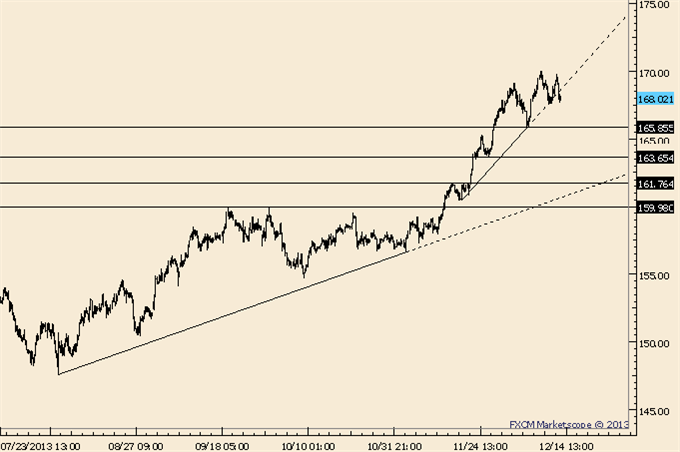
-I concern myself with trade setups and risk, not predicting what will happen next. As such, the GBPJPY may be setting up for a short.
-Price has broken through the trendline that extends off of the 11/19 and 12/5 lows. The line crosses through the 12/11 and 12/12 bars as well. From here, a ‘drift’ into the underside of the line early next week may present an opportunity to go short. 168.80 is estimated resistance.
Trading Strategy: Possible top so monitor for failure near 169 for a possible short. If this trade is taken, then plan on exiting a portion at 166.40.
EUR/NZD
4Hour
USDJPY_Trades_to_2013_and_Reverses_Trade_Setup_in_GBPJPY_body_Picture_3.png, USD/JPY Trades to 2013 High and Reverses; Trade Setup in GBP/JPY
Chart Prepared by Jamie Saettele, CMT using Marketscope 2.0
Automate trades with Mirror Trader
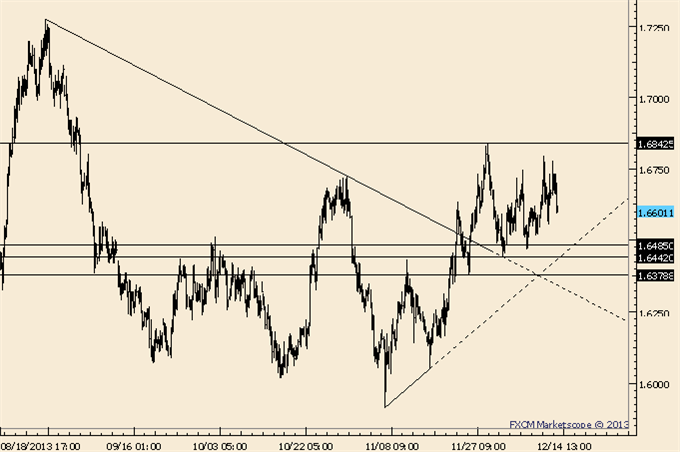
-I’ll have more on the longer term picture in EURNZD in the upcoming “Top Ideas for 2014” but near term support in the rate is estimated near 1.6485 and trendline support.
-Trade since 11/29 may prove nothing more than consolidation before the next leg higher.
-A minor upside objective is just a test of the high in August at 1.7275 although a reaction could be seen from the 8/28 close at 1.7100.
Trading Strategy: Monitoring for support at 1.6485 and/or the upward sloping trendline.
GBP/NZD
4Hour
USDJPY_Trades_to_2013_and_Reverses_Trade_Setup_in_GBPJPY_body_Picture_2.png, USD/JPY Trades to 2013 High and Reverses; Trade Setup in GBP/JPY
Chart Prepared by Jamie Saettele, CMT using Marketscope 2.0
Automate trades with Mirror Trader
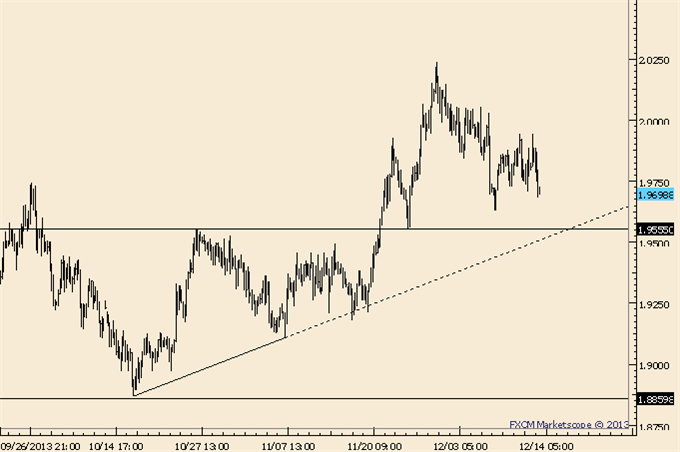
-I’m of the mind that EURNZD upside potential is greater than GBPNZD upside potential given this week’s follow through in EURGBP on the prior week’s large range key reversal. Still, this rate is worth a look and could help better time a EURNZD long anyway.
-Bottom line, 1.9550 is estimated support. That level is marked by the 10/25 high and 11/26 low. 1.9550 and trendline support intersect on 12/19 (Thursday).
Trading Strategy: Same as EURNZD…monitor for support at 1.9550.
USD/MXN
Daily
USDJPY_Trades_to_2013_and_Reverses_Trade_Setup_in_GBPJPY_body_Picture_1.png, USD/JPY Trades to 2013 High and Reverses; Trade Setup in GBP/JPY
Chart Prepared by Jamie Saettele, CMT using Marketscope 2.0
Automate trades with Mirror Trader
-Tis a tale of trendlines in USDMXN. Last week, price traded into and reversed from the resistance line that originates from the 2012 high. This week, the rate reversed just before the line that originates from the Jul low.
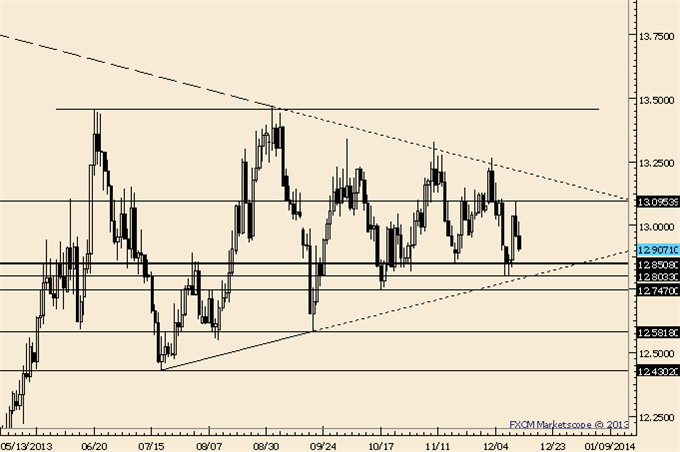
Trading Strategy: I wrote last week that “just know that the market is coiled for a large move. Price needs to stabilize before entertaining longs.” The market has stabilized. I am long with a 12.80 stop. A drop below 12.80 would shift focus to 12.70. The target is 13.16 (trade the range as long as it’s in the range).

Direct Fed Generated Volatility for Key Breakouts See to US Dollar

by Unknown  |  in Markets at  03:03
US_Dollar_Looks_to_Direct_Fed-Generated_Volatility_for_Key_Breakouts_body_Picture_1.png, US Dollar Looks to Direct Fed-Generated Volatility for Key Breakouts
US Dollar Looks to Direct Fed-Generated Volatility for Key
 Breakouts
Fundamental Forecast for US Dollar: Bullish
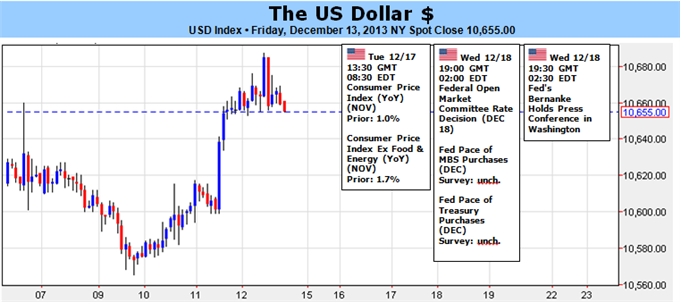
  • This is the last full week of trading this year, but the docket offers the most market-moving event: the FOMC decision
  • Though not the consensus expectation, there is enough speculation of a December Taper to keep the markets enthralled
  • The dollar’s path depends heavily on a December vs March Taper? Trade the US Dollar’s via ourMirror Trader currency basket
Like an action movie tagline: it’s a race against time for the dollar to stir volatility before 2014 runs out of liquidity. Our protagonist (or antagonist depending on your view) is the Fed; and this Wednesday’s FOMC rate decision the trial. Coming to you, this holiday season.
Regardless of what currency pair or asset class you are trading; if you are a technical trader, the charts are captivating. There are more than a few mature ranges ready for a significant breakout (USDollar), early reversals in overextended trends (S&P 500), and temporarily waylaid momentum awaiting a spark to continue their drive (USDJPY). It would seem the perfect scenario for market participants with a surplus of trade setups and the catalysts to put them into motion. However, meaningful movement beyond short bouts of volatility is the low probability scenario.
Traders looking for setups over the coming week will essentially be fighting gravity. A liquidity drain into the end of the year due to the holiday period, year-end capital flows, and market closures is about as close as we come to a natural law in the FX market and global financial markets. This week is the last, full trading week of the year as the Christmas holiday will (symbolically) fall exactly a week after the Fed’s policy meeting. That does not give a lot of time for trends to take root, and it will dissuade many from even attempt it.
Though there are few seasonality effects on the FX market, the implications of this downshift in market activity have very clear repercussions. Referring to the S&P 500 as a benchmark for traditional investor sentiment, December historically exhibits the lowest level of volume of any month of the year and it also happens to be the best month for positive return on average (from 1990 to present). The lack of turnover reflects the diminished speculative participation which will sabotage follow through and dull volatility in currencies as with all other assets. Furthermore, the bullish lean for the index speaks to an appetite for yield and prevailing trends that burdens the dollar.
A simple question: can the Federal Open Market Committee (FOMC) rate decision setoff large moves? Yes. But, the follow through is likely to be limited to the current week, and a sizable run requires we realize perhaps the lowest probability outcome. In the past month, we have seen the market significantly increase the speculation surrounding a January or December Taper (a reduction in the steady $85 billion-per-month stimulus program). Since the central bank’s surprise decision to postpone the downsizing of QE3 and the partial US Government shutdown; we have seen data steadily improve, other monetary groups warm to fresh stimulus, and the Fed maintain a distinctly hawkish attitude towards its forecasts.
This certainly moves forward the probability of a tightening from March or after to March of before. A December Taper would certainly be a bold move for a timid Fed. Nevertheless, there is enough concern of such a move, that a move can be made that we can see volatility generated from a ‘surprise’ one way or the other. Yet, if we recall the September event; there was a buildup in the S&P 500 and drop in the dollar leading into what was a heavily expected taper outcome. Is the market perhaps already prepared for the US central bank to ease back on the accelerator? The litmus test for dollar volatility – much less a dollar rally – is whether risk trends fold under the pressure of a reality of a limited support system from the Fed.
Should the Fed decide to take the easy route and defer, the situation is not exactly settled. In addition to the regular statement that accompanies this event, we are due the quarterly economic forecasts and final press conference from Fed Chairman Ben Bernanke (he retires at the end of January). Though he would not want steer the ship towards rocks just before handing over the helm, the lean towards moderation in moral hazard has been a board effort for some time. With the forecasts, commentary and data (CPI, TICs, housing) due in the week; there is plenty to set up a more active January. - JK

Proudly Powered by Blogger.